Amtrak trains need a better connection to jobs, homes, and attractions on the San Francisco Peninsula. Amtrak Thruway buses at Emeryville are scheduled to take 30 minutes subject to Bay Bridge congestion, don’t go past Powell Street, and run once per connecting train. Transferring to BART at Richmond takes more than 40 minutes to reach Embarcadero.
A new Amtrak connection to the West Oakland BART has major benefits beyond significant travel time savings. Amtrak already has a site within a 5 minute walk, where minimal construction is required.
The high cost-effectiveness of a new stop here should make it a top priority for Amtrak, BART and Bay Area transit stakeholders.

In West Oakland, Amtrak and BART cross, but don’t connect. Map by Steve Boland, circle of interest added with permission.
Major Benefits
- 10 minutes saved from Amtrak stations beyond Richmond, including Sacramento, Fresno, Stockton, Davis, Martinez, Fairfield, Bakersfield, and even Portland, Seattle and Chicago. See Travel Times Addendum below for assumptions.
- More uninterrupted travel time on comfortable, spacious Amtrak trains by transferring closer to San Francisco
- 6 minutes saved starting from Richmond to SoMa and beyond (32 minutes, a 16% improvement vs 38 minutes via BART) and 6 minutes saved from Berkeley Amtrak to SoMa and beyond (22 minutes, a 21% improvement vs. current 28 minutes via AC Transit FS.)
- New connections between Amtrak and AC Transit 14, 36, 62, 29, 314 lines, Megabus, Flix Bus, and San Francisco Bay Trail.
- Amtrak service to West Oakland/Prescott neighborhood, an MTC Priority Development Area with major development projects including Howard Terminal stadium, West Oakland Station, and 500 Kirkham.
- Increased core capacity by connecting the two largest rail networks in the East Bay at their cores
- Better detour options during disruptions to Transbay Tube, Bay Bridge, and East Bay BART or Amtrak routes. Mass transit redundancy increases total system reliability.
- Less crowding at core BART stations as transfers at West Oakland can cross using any of the four BART lines there vs. two at Richmond.
- Less traffic, cleaner air, better access to jobs, lower costs, improved quality of life, and the many other benefits of good public transit and resulting increased ridership for the whole Bay Area and Northern California.
Site Location
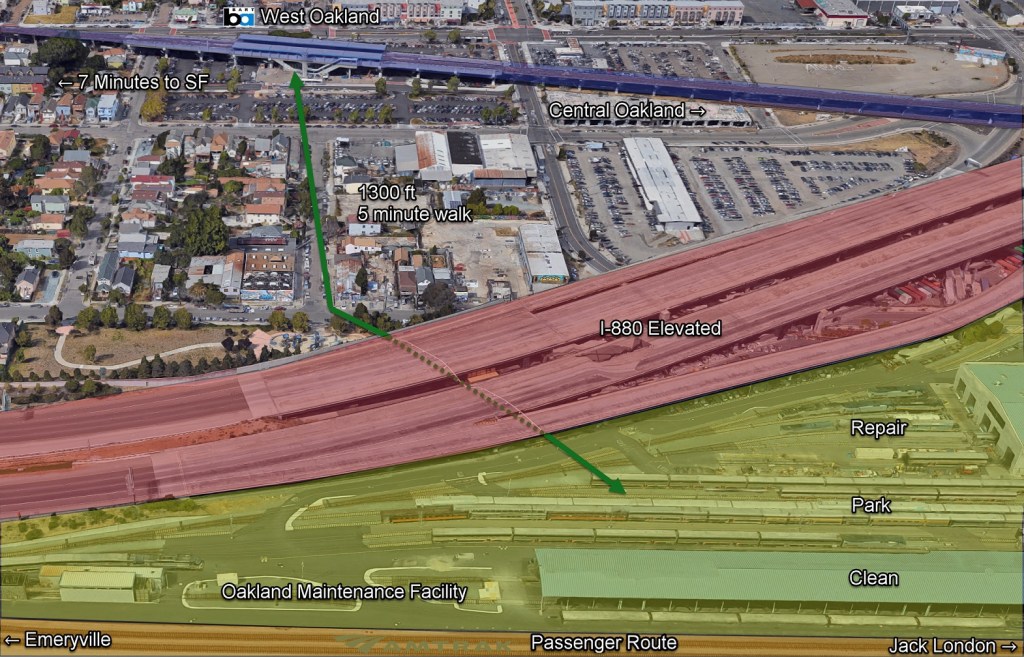
Amtrak parks its trains between the service and repair buildings at the Oakland Maintenance Facility. The northern layover track is about 1300 feet from West Oakland BART, about 5 minutes walking, shorter than Transbay Temporary Terminal to Embarcadero BART.
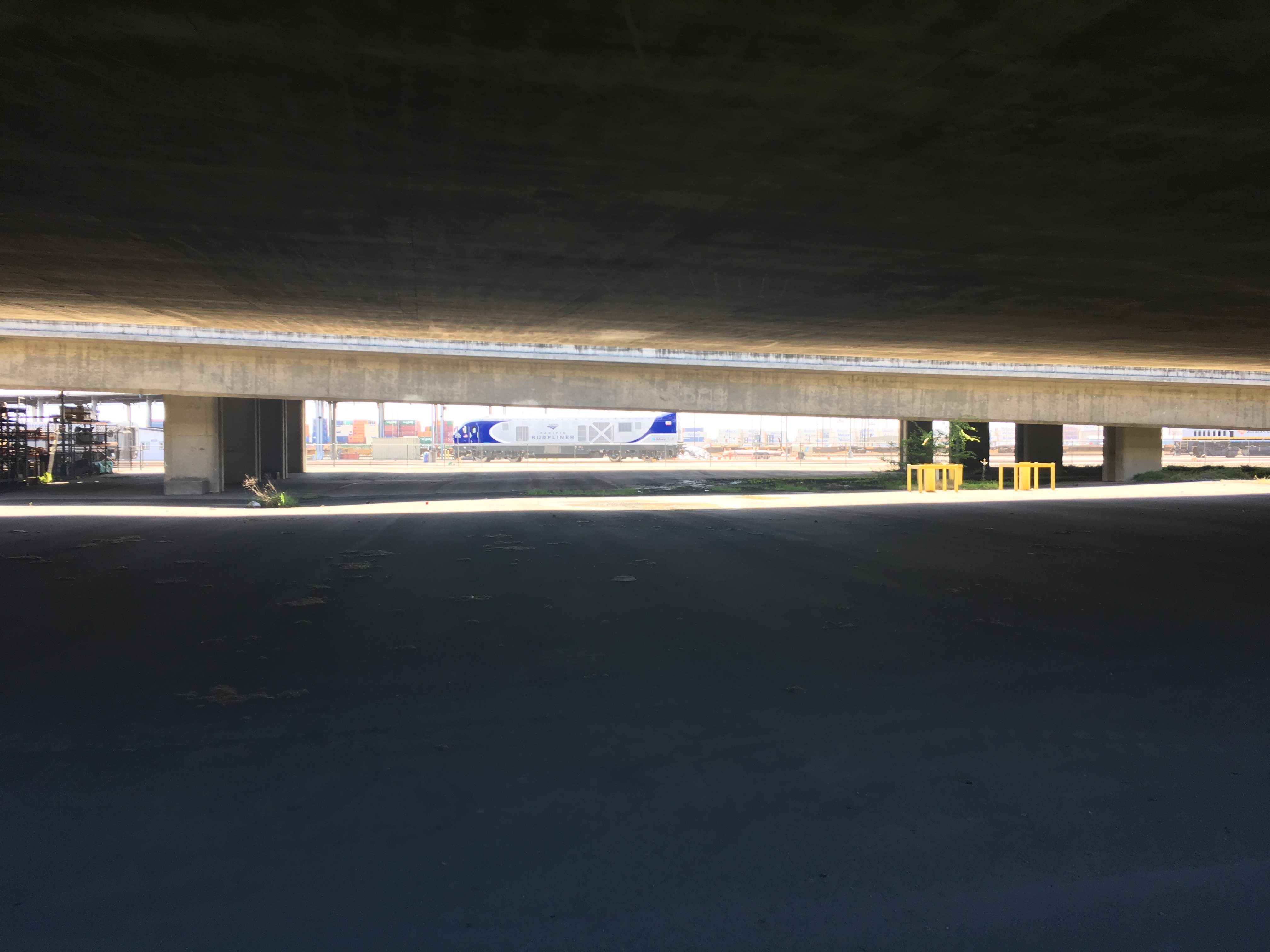
I-880 is elevated enough here that the area under is currently in use as a parking lot and storage facility. If fences were removed, a person could walk from the north side of the OMF under I-880 to Center St. and then to West Oakland BART today.

Construction Cost
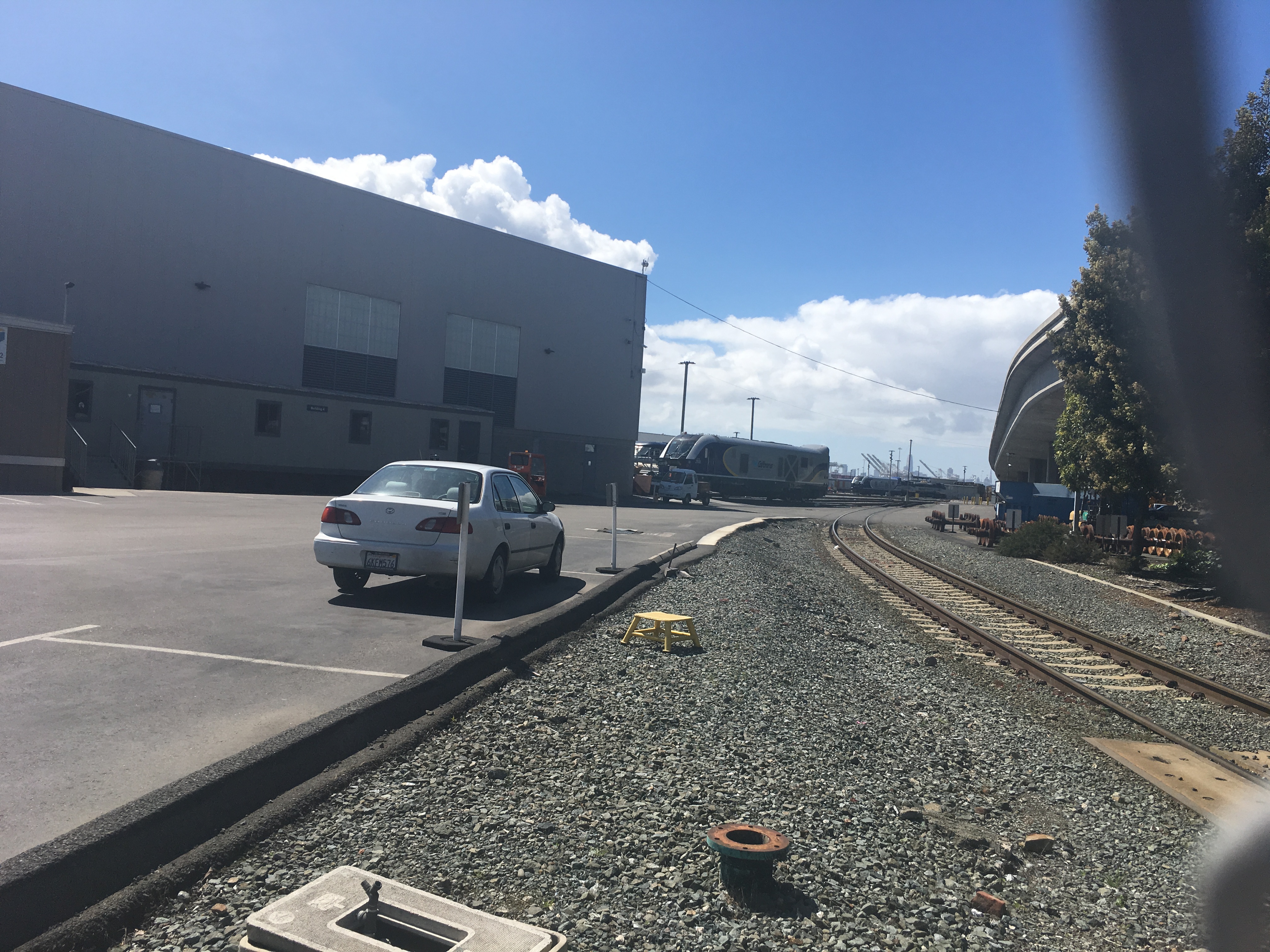
A well-designed station here will cost less than a typical commuter rail station. The intervening land is a public street, public park, elevated highway, and current Amtrak facility, so land acquisition is unnecessary, existing routes don’t need to move, and external disruption is minimal. The station would require a boarding platform, an improved pedestrian path over the tracks that connect to the repair building and under I-880, and through a playground at Prescott Park. Amtrak may need to install or upgrade rail to replace the re-purposed layover tracks.
The $40M construction of Amtrak’s Fairfield-Vacaville station included a new parking lot, bus stop, and road overpass. A West Oakland station doesn’t need those, so expected cost is lower.
Demand Effects and Other Projects
The speed, convenience and reliability improvements due to this new connection point will attract new rail passengers. That is a good thing, since today the I-80 corridor is above capacity for more hours/day, and degrades more during high demand than the Transbay Tube.
BART has about 66 times as many riders as Capitol Corridor, so even if CC ridership doubles from new riders who transfer at West Oakland, that’s only a 1.5% increase in Transbay Tube demand. For comparison, peak-hour trunk BART capacity will increase 12% by February 2020 as BART moves to 10-car trains from an average 8.9 cars/train in January 2018.
AC Transit’s transbay capacity will increase when service moves to Salesforce Transit Center, and again when Transbay Tomorrow Phase 2 completes.
A second transbay crossing is overdue. But we can’t wait 25 years for a project 200 times bigger than one new infill surface station. The Bay Area housing crisis, the congestion crisis, and the global climate crisis are worsening every day.
Travel Times Addendum
Travel time savings use assumptions from Google Maps directions.
Existing
- 31 minute ride from Richmond BART to West Oakland BART (via red line non-stop, or orange-yellow transfer at MacArthur)
- 7 minute ride from West Oakland BART to Embarcadero BART
- 12 minute ride from Richmond Amtrak to Emeryville Amtrak (4 min Berkeley to Emeryville)
- 1 minute walk from Richmond Amtrak to Richmond BART
- 1.5 minute wait for a train at West Oakland BART (1 red, 1 blue, 1 green, and 2 yellow line trains each direction every 15 minutes)
- 3.75 minute wait for a train at Richmond BART (1 red, 1 orange line train every 15 minutes)
Proposed
- 7 minute ride from Emeryville to proposed West Oakland Amtrak, 1 minute stop, and 3 minute ride to Jack London Square
- 5 minute walk from West Oakland BART to proposed West Oakland Amtrak
When the BART red line isn’t running, a Richmond transfer requires 3.75 more minutes waiting, and a West Oakland transfer takes 1.25 more minutes, so a West Oakland Amtrak stop transfer will save 12.5 minutes for passengers from beyond Richmond.
 Better Connections